A Mental Health Outreach Program That Changed the Law
Designing the first proactive suicide prevention and mental health outreach program for newly separated service members — from concept and research to Congressional authorization.
The moment the mission called
The transition out of military service is one of the most disorienting experiences a person can face. After years — sometimes decades — of structure, purpose, and community, newly separated service members suddenly find themselves navigating civilian life largely on their own. The research is sobering: suicide rates among Veterans are significantly higher than the general population, and the period immediately following separation is among the highest-risk windows.
VA had recognized this gap and, working from principles of Consistent Caring Contact — a behavioral health framework emphasizing regular, proactive outreach to at-risk individuals — had sketched the rough outline of a new program. The idea: reach out to every newly separated service member proactively, before they're in crisis, and connect them with VA mental health and benefits resources. The concept was sound. The execution was another matter entirely.
VA had never run a proactive outreach program of this kind. There was no playbook, no existing infrastructure, no tested messaging, and no clear model for how data would flow from DoD separation records into VA outreach systems. This was a zero-to-one challenge with direct implications for Veteran lives.
Project Lead, Researcher, Strategist, and Designer
I served as project lead and primary UX researcher, communications strategist, and designer for VA Solid Start — embedded with the VA staff who run the national call center, building the program from the ground up. The stakeholder landscape was demanding: the Under Secretary of Veterans Affairs, the “Big 6” Veterans organizations, Congressional committees, DoD, and the call center staff who would run the program daily.
Audience Research & Profiling
Developed in-depth audience profiles segmented by separation type, service branch, risk profile, and communication preferences — informing every downstream channel, tone, and timing decision.
Brand Strategy & Messaging
Built the VA Solid Start brand voice — warm, direct, non-clinical — and named the program itself. 'Solid' as military respect, 'Start' as a forward-looking signal. Developed the full messaging architecture and multi-channel communications plan.
Service Design & Execution
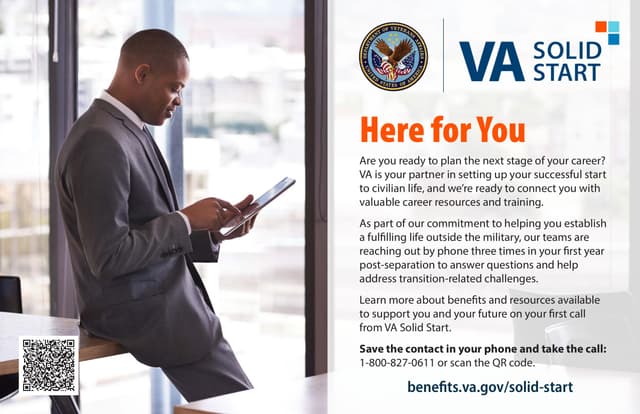
Designed modular call scripts, email lifecycle sequences, SMS, website, launch collateral, TAP integration materials, and KPI framework — every artifact the program needed to run from day one.
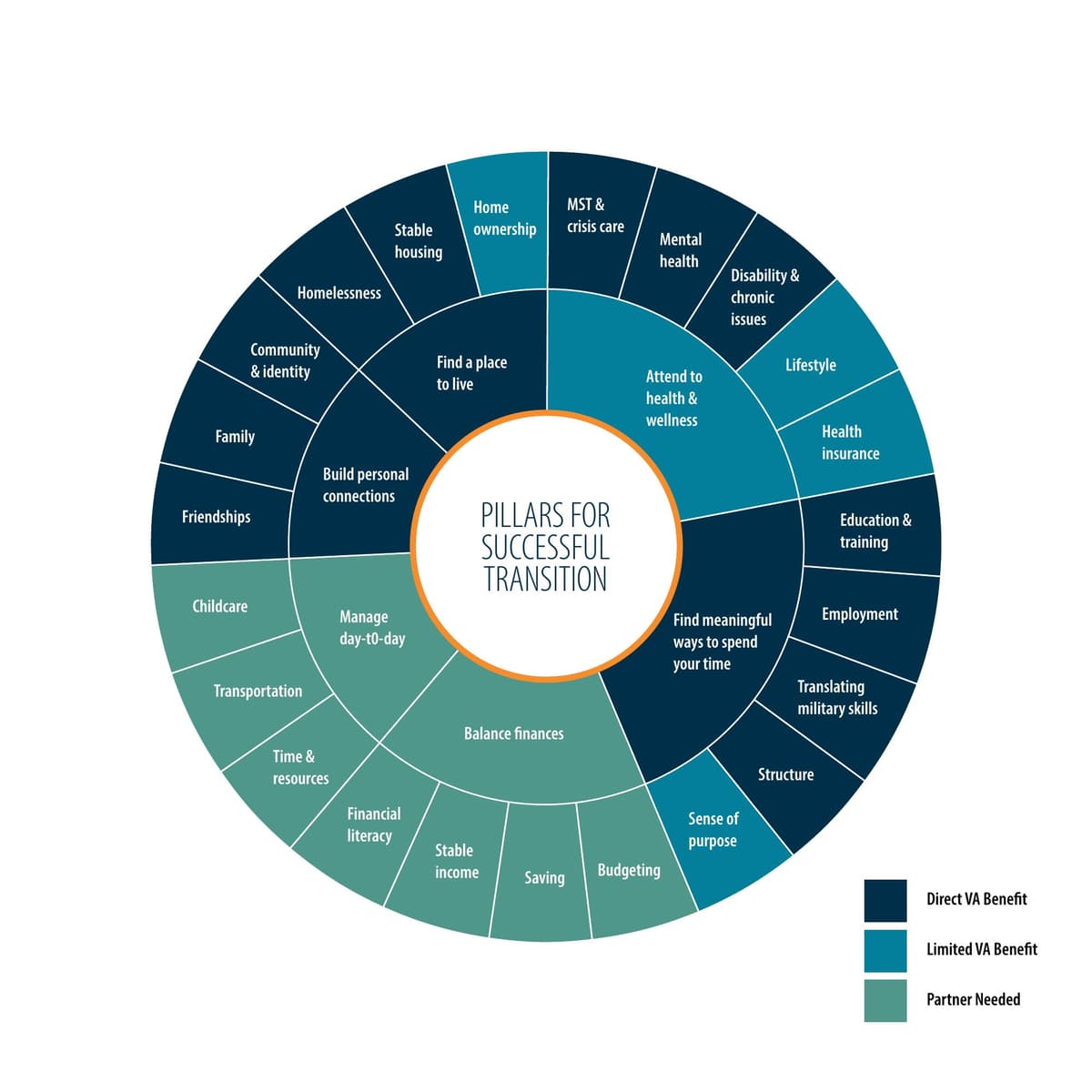
Understanding the Veteran at the moment of separation
Before we could design anything — a message, a call flow, a web page — we needed a precise picture of who we were reaching and what their world looked like in the weeks and months after leaving service.
Newly separated service members are not a monolithic audience. A 22-year-old leaving after one enlistment has a radically different set of needs, mental models, and communication preferences than a 40-year-old retiring after 20 years. Combat Veterans carry different experiences than those who served in support roles. Geographic variation, family circumstances, and benefit eligibility all shape how an individual receives and responds to outreach.
And critically — the Veteran identity itself is complex. Many newly separated service members don't yet see themselves as “Veterans,” which has direct implications for how we name, frame, and deliver the program. I developed in-depth audience profiles that segmented the population by separation type, service branch, risk profile, and communication preferences.
Building the architecture of caring contact
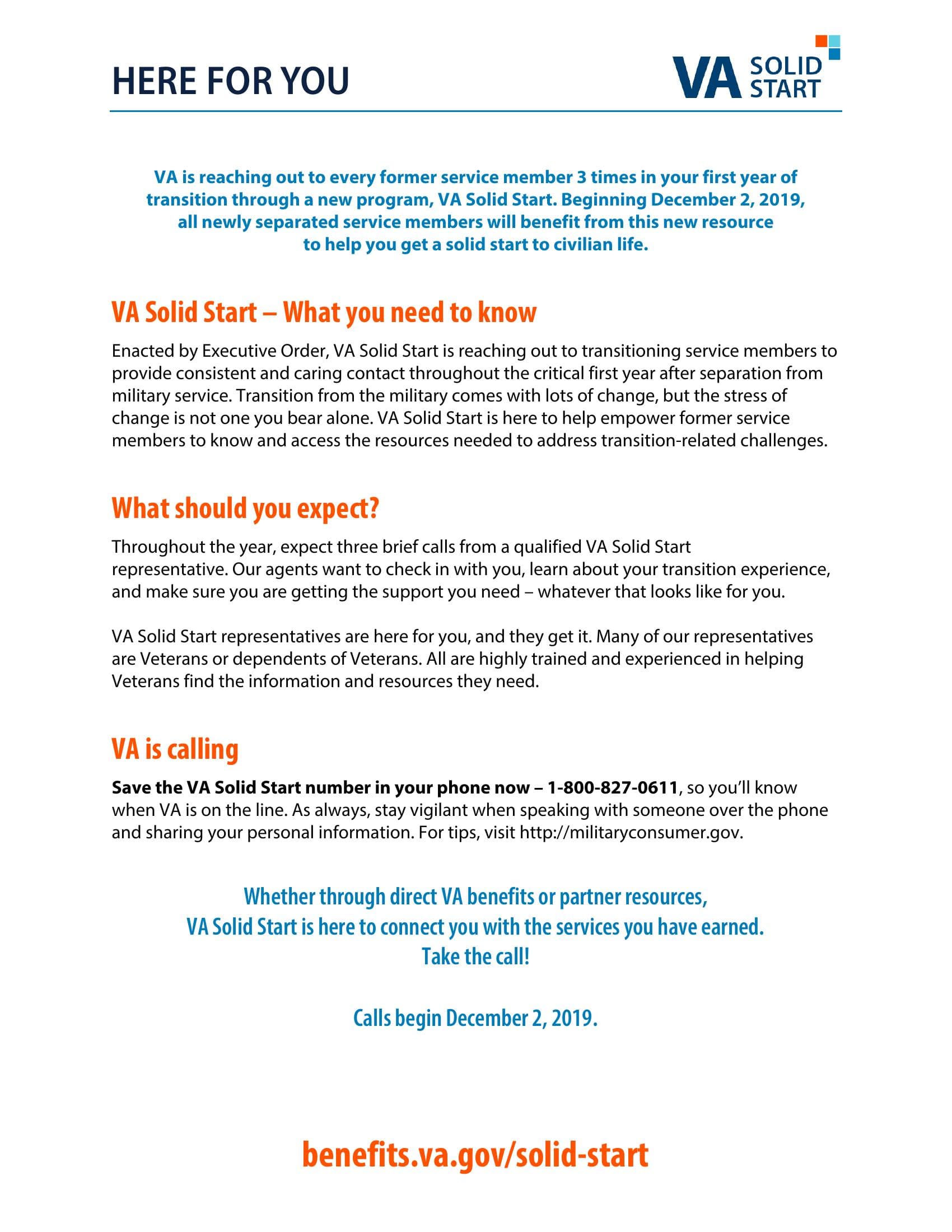
With audience understanding in place, the challenge became structural: how do you design a system of outreach that feels personal at population scale?
The contact model was designed around three active years post-separation: Year 1 (most intensive, highest risk), Year 2 (check-in and warm handoff), and Year 3 (sustainment and connection to community resources). Each year had distinct messaging goals, cadences, and channel mixes.
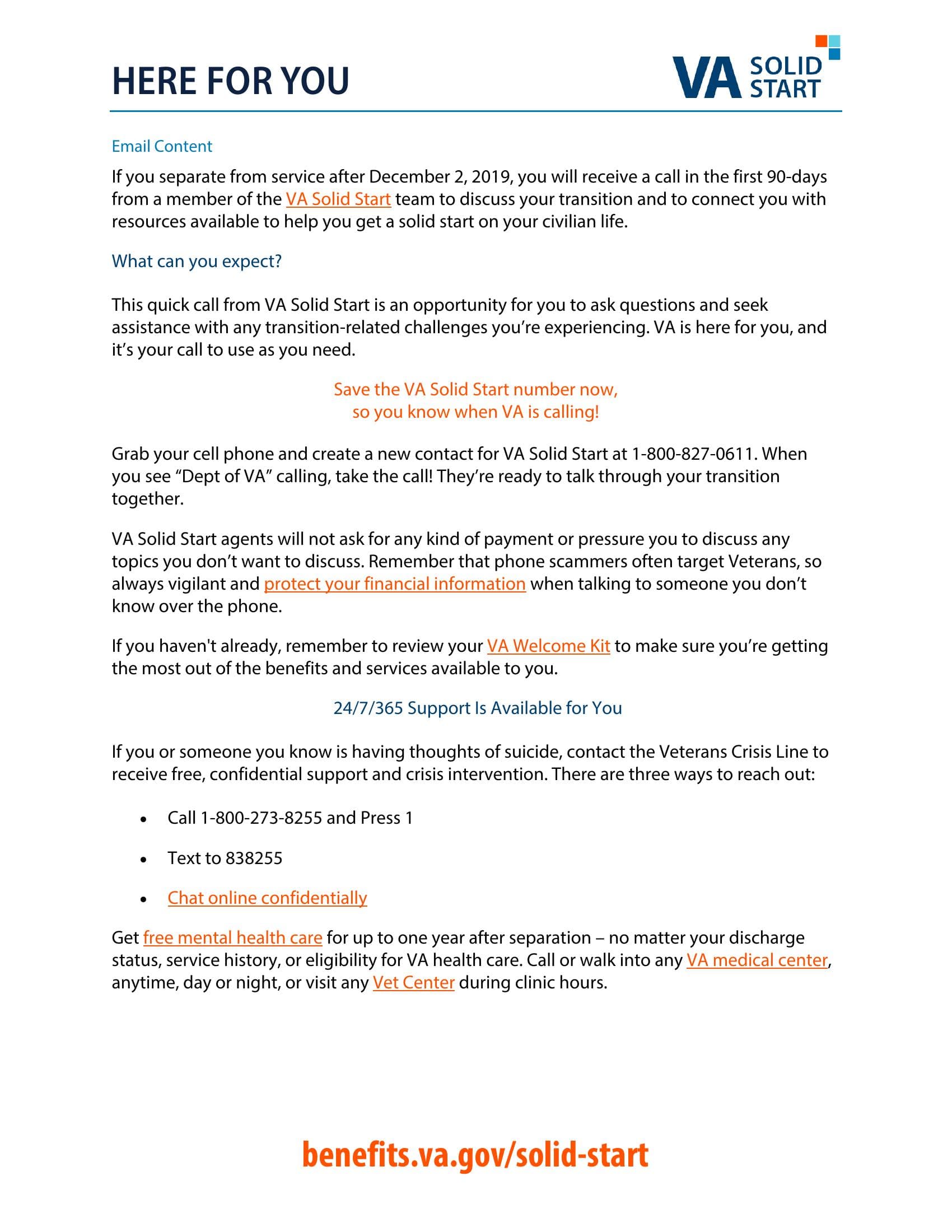
A key strategic decision was how to sequence channels. Phone outreach builds the human connection that matters most for a mental health program. But cold calls are often ignored. We designed the channel architecture so that email and text established awareness and legitimacy before calls were made — priming Veterans to recognize and answer VA outreach rather than dismissing it as spam.
“The name itself was chosen for its dual resonance: ‘solid’ as a term of respect in military culture, and ‘start’ as a forward-looking signal that this is a beginning, not a crisis response.”

Building every layer of the program
Strategy only matters when it can be executed. My role extended well beyond research and planning into the design and production of every artifact the program needed to run.
Modular Call Scripts
Designed a library of modular call scripts for the VBA call center staff — structured so agents could adapt messaging based on a Veteran's situation, response, and branch of service, while maintaining consistency in tone and key information. Tested with call center staff and refined iteratively before launch.
Email & Multi-Channel Communications
Designed the full suite of email communications — lifecycle sequences, triggered messages, and sustainment touchpoints — plus SMS and supporting print collateral. Each asset was built to work as part of the coordinated contact cadence, not as a standalone message.
Website Design
Designed the VA Solid Start web presence as the program's anchor point — a destination Veterans could be directed to, where they could learn about the program, self-schedule calls, and access resources at their own pace. Prioritized clarity, trust signals, and WCAG 2.0 AA accessibility.
Launch Collateral & TAP Integration
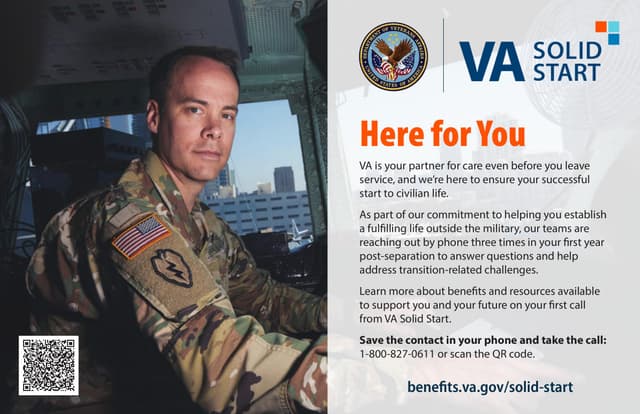
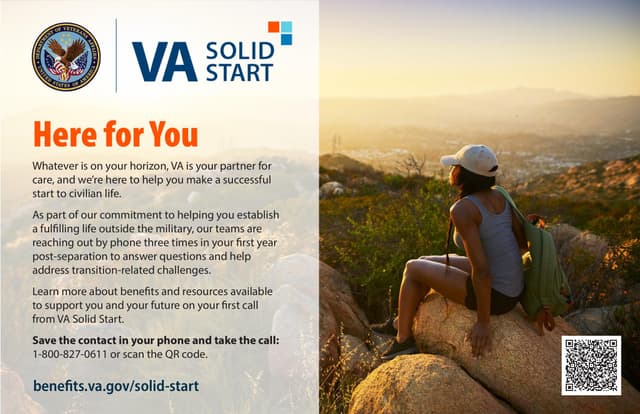
Designed materials to introduce VA Solid Start within the Transition Assistance Program (TAP) — the mandatory pre-separation counseling process — so that every service member would hear about the program before they left. This seeded awareness at the source and directly improved reception of subsequent outreach.
KPI Framework
Worked with the program team to define the key performance indicators that would measure success — not just activity metrics, but meaningful engagement signals. Defined the 15% phone connection rate as the primary success benchmark (exceeded at launch) and established email engagement and multi-year retention rates as secondary measures.
What made this hard
Bridging Two Bureaucracies: DoD → VA Data Flow
For the program to work, VA needed separation data from DoD systems in near-real time — but the two agencies operate on entirely different data infrastructures with limited interoperability. I worked with engineering and data teams to map the complete data workflow from DoD separation records to VA outreach systems, establishing data transfer protocols, exception handling for edge cases, and validation checkpoints to ensure no Veteran fell through the cracks.
Designing for Trust in a Low-Trust Environment
Many Veterans carry deep skepticism toward VA, rooted in well-documented failures of the past. An outreach call or email that feels scripted, generic, or out of touch can actively damage the relationship it's trying to build. Every messaging and design decision was stress-tested against this reality — leading to an unusually human tone for a federal program, and deliberate channel sequencing to build recognition before asking for engagement.
Stakeholder Alignment Across Competing Priorities
VHA and VBA have distinct mandates, cultures, and organizational priorities. Coordinating campaign assets across VA administrations, validating messaging with the Big 6 Veterans organizations, and presenting the program to Congressional committee staff required translating the same work into multiple registers — operational, clinical, political, and community. Achieving alignment without diluting the program's core design was a sustained negotiation.
Building a Measurement Framework Before There Was Any Data
Because this was the first program of its kind, there were no benchmarks — no prior VA outreach campaigns to reference, and limited comparable data from other agencies. Defining what 'success' looked like required rigorous thinking about what mattered (not just what was measurable) and enough conservatism to set targets we could beat, building early credibility for the program's continuation and funding.
A program that changed the law
Email open rates vs. ~3% government average
Phone connection rate at launch — exceeding the 15% target
Major Veterans organizations endorsed the program
Solid Start Act of 2022 — permanently authorized by Congress
The email performance was particularly notable. Government email programs routinely achieve open rates in the low single digits. VA Solid Start's 20–40% range placed it in the same territory as the best commercial email programs in the world — a direct consequence of research-grounded segmentation, message relevance, and the trust that careful brand work had built.
“In October 2022, President Biden signed the Solid Start Act of 2022 (P.L. 117-205), permanently authorizing and expanding VA Solid Start — requiring VA to coordinate with DoD to reach every Veteran three times in their first year after separation.”
Programs that start as pilots and get killed are the norm. Programs that get written into law are not.
What this work taught me
VA Solid Start was one of the most complete design challenges I have worked on — not because it was technically complex (though the data infrastructure work was genuinely hard), but because it required holding the full picture in mind simultaneously: the vulnerable human at the end of the outreach, the operational staff making the calls, the bureaucratic systems that had to be bridged, and the political stakeholders whose support determined whether the program would survive.
It reinforced for me that the most important design work often happens before anyone opens a design tool. The audience research that shaped the tone of every message. The data flow mapping that made personalization possible. The stakeholder engagement that built the coalition the program needed to survive its first year. These aren't UX deliverables in the traditional sense — but they are design. The design of the conditions under which good work can exist.
The number that stays with me isn't the open rate or the connection rate. It's the Veterans — measured in the tens of thousands — who received a call they didn't know to expect, from an organization they had reason to distrust, that made them feel seen. That's what human-centered design is actually for.
About the program & the legislation
The bill that permanently authorized VA Solid Start, signed October 2022.
Comprehensive Veterans' mental health legislation that further reinforced the program, signed December 2022.
VA's official overview of the Act's scope and provisions.
USTRANSCOM Patient Movement
Interface redesign praised for saving lives